Understanding Christmas Background Vector Illustration for Modern Design Projects
In the realm of digital design, selecting the right visual assets is often the difference between a generic output and a professional-grade creation. Christmas Background Vector Illustration has emerged as a preferred resource for creators ranging from hobbyist crafters to commercial graphic designers. These digital assets are distinct because they utilize mathematical paths rather than pixel grids, allowing for infinite scalability without loss of quality. Whether you are crafting a festive social media banner featuring realistic pine leaves or designing intricate vinyl decals for holiday merchandise, vector files provide the precision necessary for high-end results.
When evaluating options for holiday-themed graphics, it is essential to understand how these illustrations compare to raster-based images like JPEGs or PNGs. The core advantage lies in flexibility. A standard photograph might capture the texture of snow perfectly, but if you need to enlarge that image to fit a large billboard or shrink it for a small sticker, the pixels will blur or become jagged. In contrast, a Christmas background vector illustration retains its crisp edges regardless of size. This makes them particularly valuable for applications requiring specific dimensions, such as cutting machines or large-format printing.
Distinguishing Features of Vector Art vs. Raster Alternatives
The decision to use vector files over traditional raster images often comes down to the intended application. Raster images are composed of a fixed grid of colored squares called pixels. When you zoom in too far, you see the individual blocks, resulting in a blurry appearance. Vector graphics, however, are defined by points, lines, curves, and shapes based on mathematical formulas. This fundamental difference means that a Christmas banner with decoration balls created as a vector can be resized from the size of a business card to the height of a building without any degradation in visual fidelity.
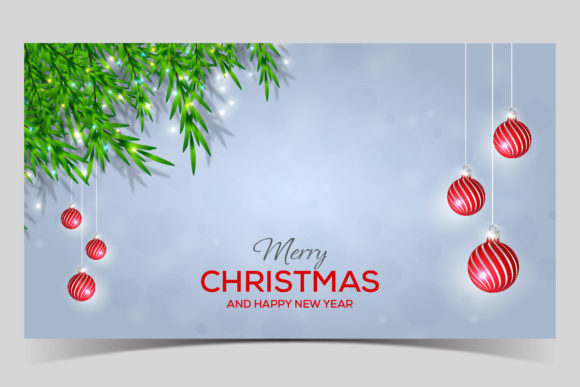
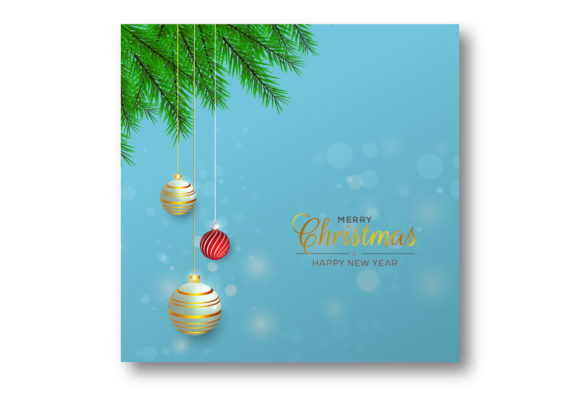
Consider the specific design elements often found in holiday collections, such as banners with white, blue, and red balls alongside realistic pine leaves. In a raster format, the transition between the green of the leaf and the white of the snow must be pre-rendered. If the resolution is insufficient, the edges appear fuzzy. With a vector approach, the software recalculates the geometry every time the file is rendered. This ensures that the curve of a pine needle remains sharp and the gradient on a decorative ball looks smooth, even when manipulated.
Furthermore, vectors offer superior editability. In many design scenarios, a user may need to change the color of the blue balls to gold or remove a specific element to fit a new layout. While this is possible with raster tools, it is often labor-intensive and destructive to the original image quality. Vector files allow for non-destructive editing, where individual components can be selected, moved, recolored, or deleted independently. This level of control is crucial for designers who need to adapt a single asset for multiple uses within a campaign.
Evaluating File Formats and Technical Requirements
When acquiring these digital assets, the file format determines the workflow compatibility. A comprehensive package typically includes multiple formats such as Ai (Adobe Illustrator), EPS, PDF, SVG, and High-Resolution Vector files. Each serves a specific purpose depending on the software being used.
- Ai Files: These are native Adobe Illustrator files. They are ideal for professionals who need full access to layers, editable text, and advanced path manipulation. If you are working within the Adobe ecosystem, this is the primary format to utilize.
- EPS Files: Encapsulated PostScript files are widely compatible across various design platforms, including older versions of CorelDRAW and Inkscape. They preserve vector data and are excellent for print workflows.
- SVG Files: Scalable Vector Graphics are web-friendly and perfect for digital displays. They are lightweight and render instantly in web browsers, making them suitable for online Christmas posts and website headers.
- PDF Files: Portable Document Format files are versatile for both viewing and printing. They maintain vector integrity and are commonly used for sharing designs with clients or sending files to commercial printers.
- High-Resolution Vector (300 DPI): While technically a vector concept, some packages include rasterized versions at 300 DPI for immediate use in photo editing software like Photoshop. This provides a safety net for users who need a quick, high-quality image without needing to open a vector editor.
It is important to note that these files are usually compressed into a single ZIP archive to facilitate easy downloading and organization. To access the contents, users require extraction software such as WinZIP, WinRAR, or the built-in extraction tools available in modern operating systems. Simply double-clicking the ZIP file often triggers an automatic extraction process, revealing the organized folder structure containing all the necessary assets.
Practical Applications Across Creative Industries
The versatility of Christmas social media banner with realistic pine leaves extends far beyond simple digital display. Because these assets are scalable and editable, they serve as foundational elements for a wide array of physical and digital products.
For those utilizing cut machines, such as Cricut or Silhouette, vector files are indispensable. These machines read the path data to guide the blade precisely along the lines of the design. A Christmas banner on a dark background designed as a vector allows for clean cuts through vinyl, cardstock, or iron-on transfer material. Without vector data, the machine would struggle to interpret the complex curves of the pine needles or the circular shapes of the decorations, leading to messy cuts and wasted material.
In the realm of apparel and merchandise, these illustrations are used for screen printing, direct-to-garment (DTG) printing, and embroidery digitizing. The ability to separate colors and adjust sizes ensures that a design featuring red, white, and blue balls can be adapted for a t-shirt, a tote bag, or a mug without losing detail. Similarly, for engraving projects, the precise lines of a vector file ensure that the laser cutter or engraver produces a clear, detailed image on wood, metal, or acrylic surfaces.
Printable decoration and stationery also benefit significantly from this technology. Creating invitations, greeting cards, or scrapbooking layouts requires high-resolution imagery that can be printed on standard home printers or professional offset presses. Since the source is a vector, the designer can scale the Christmas social media post with decorative elements to fill an entire page or reduce it to a tiny embellishment, ensuring that the final print is always sharp and professional.
Weighing Tradeoffs and Decision Factors
While the benefits of using Christmas Background Vector Illustration are substantial, it is not always the only option, nor is it always the best fit for every scenario. Understanding the limitations helps in making informed decisions. For instance, if a project requires photorealistic textures, such as the specific grain of a wooden ornament or the complex lighting reflections on a glass bauble, a high-quality raster photograph might initially seem more appropriate. Vectors excel at clean lines and solid colors, though modern techniques can simulate textures; however, achieving true photographic realism is often easier with raster images.
Another consideration is the learning curve. Working with vector software like Adobe Illustrator or Inkscape requires a different skill set than using basic photo editors. Users must understand concepts like nodes, anchors, and paths. If a user's primary goal is to quickly slap a holiday image onto a flyer without editing, a ready-made JPEG might be faster. However, if the user anticipates needing to resize the image later or integrate it into a larger, custom layout, investing time in learning vector workflows pays off in the long run.
Cost is also a factor. While free vector resources exist, high-quality, professionally designed sets often come with a price tag. When comparing options, one must weigh the cost of a premium vector pack against the potential cost of hiring a designer to create custom artwork from scratch. Often, purchasing a comprehensive bundle that includes Ai, EPS, PDF, and SVG files offers better value than buying individual images repeatedly for different projects.
Ultimately, the choice depends on the end goal. If the objective is to produce physical items via cutting machines, printing, or engraving, vectors are almost certainly the superior choice due to their scalability and precision. For purely static web graphics where resizing is not required, high-resolution raster images may suffice. However, given the prevalence of responsive web design and multi-device usage, having a vector source provides a future-proof solution that accommodates changes in layout and size requirements.
By carefully evaluating the specific needs of a project—whether it involves creating a Christmas banner with leaves, white balls, blue balls, and red balls for a corporate event or designing personalized gifts for family—creators can select the most effective tools. The availability of diverse formats within a single ZIP file ensures that whether you are a beginner using a simple viewer or a pro using advanced design suites, the assets remain accessible and functional. This flexibility is what defines the enduring value of vector illustrations in the holiday design landscape.